
How to plan a dining room? Table, chairs, lighting and interior layout
The dining room is not just a place for eating meals – it is something much more than that. It is a space where we meet our family every day, share meals, talk, and strengthen family bonds. That is why it is important for the dining room to meet our expectations and be practical, comfortable, and aesthetically pleasing. Below you will find tips that will help you design this space.
Where to start when planning a dining room?
First of all, you should take into account:
- number of household members
- frequency of hosting guests
- available space
- possibilities of placing the table (shape, size)
- overall interior style
- future needs (e.g. adapting the space for children or elderly people)
What dining table should you choose?

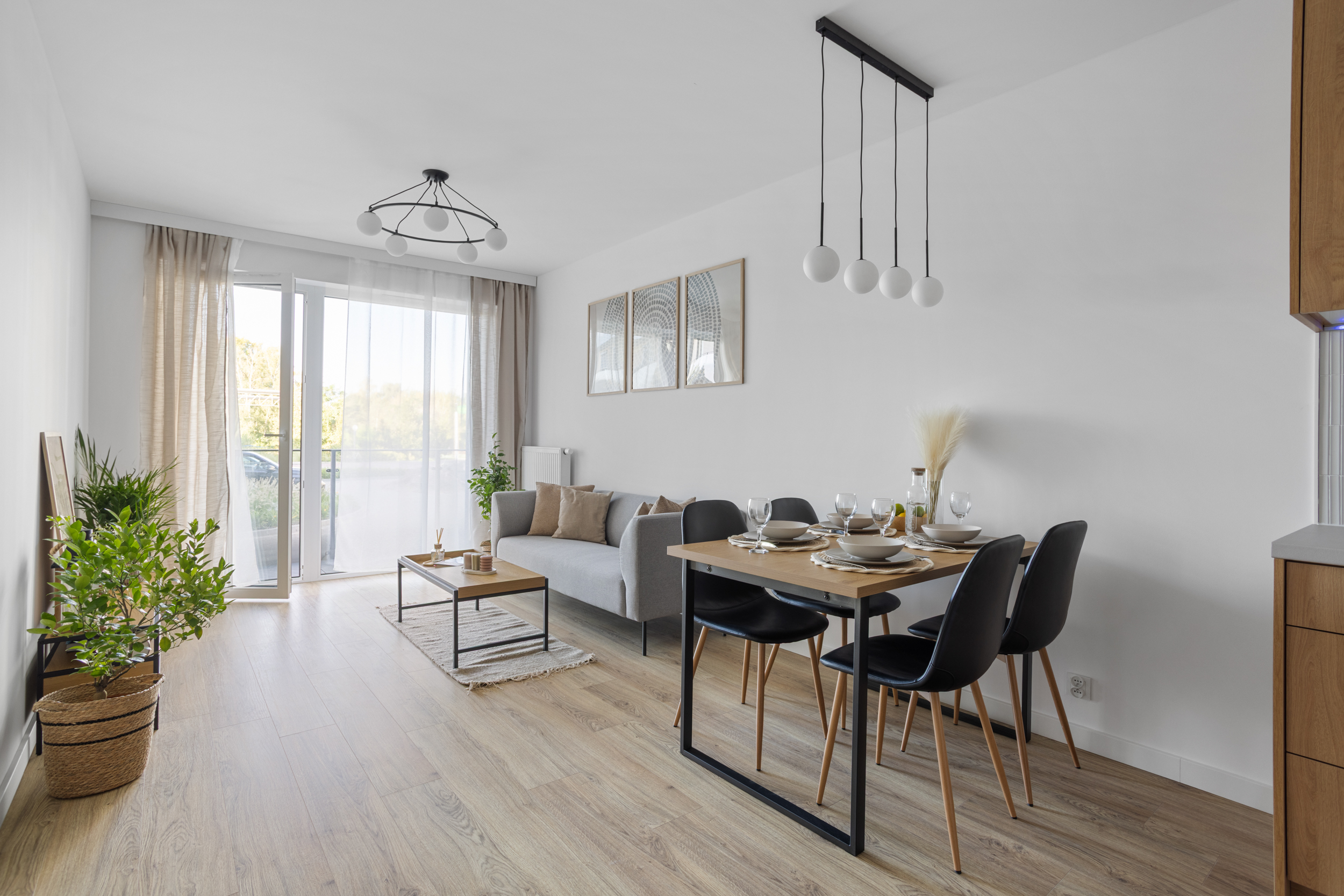
In stores you will find square, rectangular, round, as well as pentagonal or oval dining tables. Depending on how much space you have and what your needs are, you can choose the right table. It is worth remembering that a round table with a diameter of 90 cm takes up less space than a square table measuring 90 × 90 cm. Moreover, a round table can usually seat more people.
Oval or rectangular tables with rounded corners also tend to look visually lighter and make the interior feel more spacious. It is also worth considering a extendable table, which on a daily basis does not take up much space, but can comfortably accommodate guests when needed.
What chairs should you choose for the dining room?
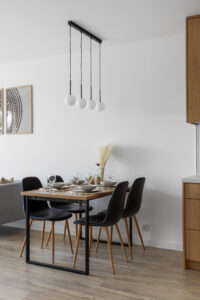
Remember that dining chairs are not only meant to be decorative elements. They are primarily designed for sitting, so they should be comfortable. Appearance alone is not enough to choose the perfect chair. Before buying, it is recommended to sit on the chair for about 10 minutes and observe how you feel. If you start to fidget or experience back pain, it is a clear sign that the chair is not right for you. On the other hand, if after 10 minutes you feel no discomfort, it may be worth considering that model.
Did you know that not every chair is designed for long, comfortable dining? Sometimes its purpose is the opposite – to discourage people from sitting too long. A good example is fast-food restaurants, where chairs are often hard, smooth, and not very “embracing.” They are practical because they are easy to clean, but they also have another function: after a few minutes, people naturally start thinking about finishing their meal and freeing up the table for the next guests.
A similar mechanism can be observed in some offices. The person in a position of authority often sits in a large, comfortable chair, usually higher and behind a solid desk, while the visitor gets a lower, less comfortable seat. This is not only about interior design, but also a subtle message: whoever controls the space often also influences the course of the conversation.
How much space should be left around the dining table?
When planning a dining room, it is important to consider the space needed to comfortably pull out chairs. There should be at least 90 cm of free space between the edge of the table and the wall. If chairs are pulled out and someone is sitting at the table, it is recommended to leave about 60 cm between the back of the chair and the wall. If the area behind the chairs is a passageway, 90–120 cm is recommended between the back of the chair and the wall or other furniture.
Key dimensions to remember:
- 45–50 cm – width of space per person at the table
- 60 cm – minimum distance between chair back and wall
- 90–120 cm – distance between chair back and wall when a passageway is needed
How to choose lighting above the dining table?
The bottom edge of a pendant lamp above the table should be placed no lower than 76 cm and no higher than 86 cm from the tabletop. This height provides proper illumination of the table while ensuring the lamp does not obstruct dining or conversation.
Advantages and disadvantages of an open-plan kitchen with dining area
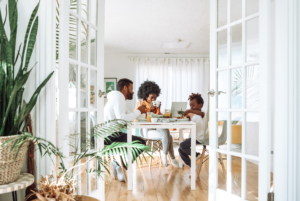
Advantages of an open-plan kitchen with dining area
- The open space encourages spending time together as a family.
- The interior feels larger and brighter.
- A cohesive design creates a modern look.
It is worth considering quiet solutions such as soft-close cabinets, a quiet extractor hood, or chair pads, which significantly improve everyday comfort.
Disadvantages of an open-plan kitchen with dining area
- Cooking smells spread throughout the living area, so effective ventilation is essential.
- Noise from food preparation may disturb household members and guests.
- The kitchen is constantly visible, so even small messes are noticeable.
- All zones should be designed in a consistent style, which can limit design flexibility.
Frequently asked questions about dining room design
Is it worth placing a rug in the dining room?
Yes, as long as it is larger than the table and made from an easy-to-clean material.
How many chairs should you choose for a dining table?
It is best to base this on the number of household members and allow extra seating for guests. Chairs should be comfortable and fit easily under the table.
What dining table is best for a small apartment?
The dining table is the heart of the dining area, so its choice should depend not only on style but primarily on the number of household members and available space. In narrow rooms, rectangular tables placed along the wall work well. In smaller apartments, an extendable table is a practical solution, as it does not take up much space daily but allows comfortable seating for guests when needed. A round table encourages conversation and works well in open spaces, although it requires more surrounding space.
What are the latest trends in dining room design?
Currently, dining room design is dominated by natural materials, warm colors, and minimalist forms. Popular choices include wooden tables, upholstered chairs, designer lighting, and accessories that give the interior a cozy and timeless character.