
How to really lay tiles in the bathroom – 6 myths we still believe in
1) The tiles do not have to match each other’s patterns.
Even if it might seem that they should, more and more often manufacturers do not provide for this possibility. As a result, two out of five tiles in the pack include those that could possibly continue the pattern. Insisting on doing this at all costs is costly because the contractor has to shuffle tiles, thus using more tiles.
2) One type of tile adhesive for the entire bathroom
Generally, there are two types of tile glue: gray and white glue. They differ primarily in the color of the cement used as a binder. Why should we pay attention to the color of tile adhesive? If a glass mosaic (especially with a white color), conglomerate tiles, light stoneware tiles or natural stone tiles are to be installed in the bathroom – gray glue may change their color. As a result, permanent discoloration will appear on the tile, which cannot be removed with anything.
3) Tiles can be laid in any conditions
The conditions under which a given type of tiles can be laid are determined by the technical grid included in the package. There you can find information about the appropriate temperature and humidity. However, it is worth remembering that according to the standards, tiles should be laid at a humidity of 55% and a temperature of 23-25 ºC. Knowledge of this standard is important because if the temperature is too high and the humidity is too low, the glue may set too quickly. And vice versa – if it is too humid and too cold, the adhesive mortar will need more time to properly bind to the substrate. Both situations may result in tiles being much more exposed to mechanical and thermal effects in the future. Ultimately, there may be a risk of the tiles detaching and falling off the substrate.
4) Only use strips on protruding corners
Yes, the strip can be used. There was a time when performers used it passionately, no matter what. Using a finishing strip on protruding corners, e.g. on a toilet building, allows the work to be completed faster. However, there is another way to finish corners, which is more aesthetic. Just cut the tiles at an angle of 45 degrees (so-called chamfer) and adjust them accordingly. The exception is glass mosaic.
5) Only small tiles are suitable for a small bathroom
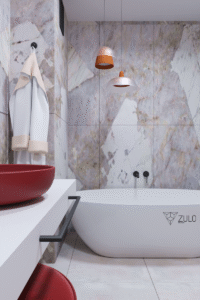
In fact, it should be the other way around. The larger the tile format, the larger the bathroom appears. Of course, it is more difficult to lay larger tiles in a small bathroom, hence the belief in small tiles.

This is no longer necessary 🙂 The old technology of laying tiles involved soaking them, but this is not necessary at the moment. On the contrary, it may harm both the adhesive mortar and the tiles.