
Modern home and apartment heating systems
Infrared heating
Infrared heating works by incorporating infrared heaters into mats, which, like sunlight, are designed to warm the room. Infrared heating can be successfully applied to walls, both in the form of mats, and to ceilings, and can be controlled via remote control or an app.
A significant advantage of infrared heating is its energy efficiency and environmental friendliness. Infrared heat doesn’t heat the air, but only objects and people, which reduces dust and allergens in the air. Furthermore, the perceived temperature is up to 3 degrees higher than the actual temperature, and the attractive design of the heating panels can be used as a decorative element in the interior.
It’s worth noting, however, that infrared heating doesn’t heat water, so a water heater or other energy source is necessary. Infrared heating works best in buildings with good insulation; otherwise, its effectiveness decreases. Electric heating is primarily used, which isn’t always feasible.
Electric underfloor heating
Although water-based underfloor heating is the most popular, electric underfloor heating, made from heating mats, is becoming increasingly popular.
Special heating mats can be used under both tiles and laminate flooring; the only requirement is a stable subfloor – concrete, screed, or (optionally) OSB board. Their energy efficiency is very high, and their ease of installation means that a skilled professional can install them throughout an entire apartment in just one day.
Electric underfloor heating is controlled by controllers mounted on the wall in each room. More and more controllers can be connected to a smartphone app, allowing for remote temperature control.
Similar to infrared mats, electric heating mats can only heat the room. Therefore, an auxiliary solution for heating the water is necessary. Furthermore, in the event of a power outage, the mats stop working, leaving the room unheated. However, when comparing traditional underfloor heating to electric, the greatest advantage of electric underfloor heating is the ease of removal and repair in the case of laminate or wood floors. Just remove the floor and you have access to everything.
Heat pumps
A heat pump is a device that transfers energy extracted from the environment to central heating and domestic hot water systems. It is an ecological heat source, obtaining up to 75% of its energy from the environment. As a result, a heat pump not only allows us to heat our homes but also helps reduce environmental emissions.
The market offers:
- Ground-source heat pumps – powered by the earth’s heat, and depending on the energy extraction method, ground-source heat pumps can be equipped with horizontal or vertical collectors (probes). The collectors are filled with a solution with a low freezing point, which extracts heat from the earth’s interior. The collector then transfers the extracted energy to the device. Horizontal collectors are installed relatively shallowly in the ground, slightly below the freezing zone. The biggest disadvantage of horizontal collectors is their large footprint. Vertical probes are single loops of pipe inserted into the ground, placed even several dozen meters underground. This solution is suitable for locations with limited plot space. The advantage of ground-source heat pumps is their stable operation regardless of the outside temperature, but the main disadvantage is the high investment cost.
Water-to-water heat pumps – in this type of solution, heat is extracted from groundwater, for example, by constructing an intake and discharge well. However, in this case, using water resources may require obtaining appropriate water permits.
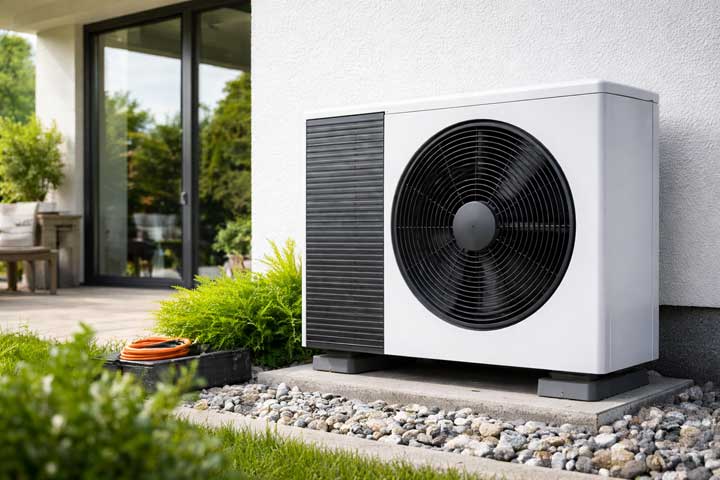
Air-to-water heat pumps – this is one of the most popular solutions that utilizes energy from the air. The biggest advantage of this type of pump is installation, which is much simpler than ground-source pumps. However, a disadvantage is a decrease in the device’s efficiency, which is associated with a drop in outside temperature. It is worth noting that some air-source heat pump models can be successfully used in apartment buildings by placing the unit on a balcony.
Condensing gas boilers
Although gas boilers are a common solution, we’re hearing more and more about new types, condensing boilers. How do they differ from the others? Traditional boilers burn solid fuel—gas—and use a flame to heat water for use. Modern condensing boilers extract heat from the combustion of gas, but also from the heat contained in the exhaust gases. This type of boiler cools (condenses) the exhaust gases to low temperatures, allowing all the energy to be released into the system. When installing a condensing gas boiler, it’s essential to install a drain, as the acidic condensate created during cooling must be discharged into the sewer system.