
Attic apartment and interior layout changes – what to check before buying and how to legally remodel the space?

Can we move the kitchen to the living room and tear down the partition walls – the law in a secondary market apartment?
If you live in a housing cooperative, there’s no requirement to report the intention to demolish partition walls. If you own the apartment, you can remove any frame or brick partition walls (thickness is usually defined as walls up to 12 cm, but can also be up to 16 cm). Partition walls serve no structural function in the building and do not affect its stability.
When might demolishing partition walls be a cause for concern?
The exception is units belonging to a housing cooperative. If the owner holds a cooperative tenancy or cooperative ownership right to the unit, the owner may be asked to provide a demolition permit, even from the city hall. For your own peace of mind, you can apply for one. However, according to numerous rulings from the Supreme Administrative Court, demolishing partition walls does not affect the building’s cubic capacity, floor area, number of floors, or height, length, and width. This means that it is not classified as conversion.
The same applies to moving the kitchen into the living room. We can do this without a permit, as long as we don’t disturb any structural elements of the building (load-bearing walls, ceiling, ventilation duct installation, etc.). It’s worth remembering that we can only move the kitchen into the living room if the room is adjacent to a bathroom. Then, connecting the ventilation or water and sewage connections won’t be a problem.
What else is worth remembering?
Be especially careful when dealing with apartments in prefab buildings from the 1970s. If you’re planning to demolish walls, carefully check to see if they’re structural. I remember a situation where all 10-centimeter walls in one apartment turned out to be structural. Demolishing them would have had disastrous consequences for the stability of all the ceilings on the first floor.
Remember to have the ventilation system checked by a chimney sweep if you plan to relocate it.
Pay attention to the gas pipes and avoid damaging them at all costs. Also, remember that after renovations, the gas meter cannot be placed in a bathroom or in a kitchen directly connected to the living room.
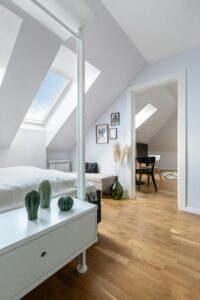
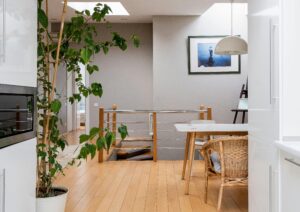
Before you move into the attic…
Check carefully how the roof is constructed and how well it’s insulated. A thick mineral wool filling will prevent the attic from overheating in the summer.
Attic apartments are warmer than ground-floor apartments. This is especially noticeable in summer, so consider whether these are comfortable conditions for you.
Attic apartments in tenement buildings often don’t have elevators. Consider whether your fitness and health will allow you to climb them daily.
Be sure to have your roof inspected by a qualified professional. Even pay extra to have them uncover the area and verify the condition of the trusses. If something goes wrong, develop a contingency plan. Don’t rely on a quick response from the property manager or housing cooperative, as in many cases, roof repairs require several months of preparation and action.
Carefully check the apartment’s floor area. In many cases, the actual dimensions are given as the floor area. This is incorrect. Legal regulations state that the entire area can only be calculated if the height is at least 2.2 meters. However, if the height is between 1.4 and 2.2 meters, the area should be calculated as 50% of the actual area.