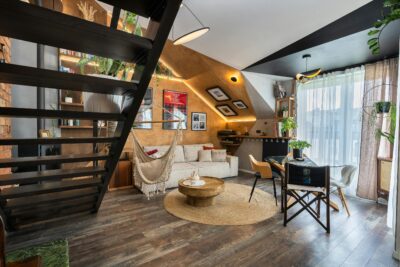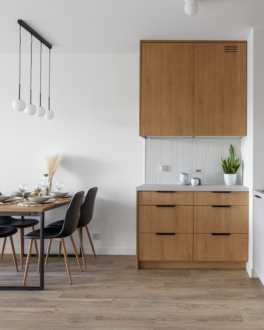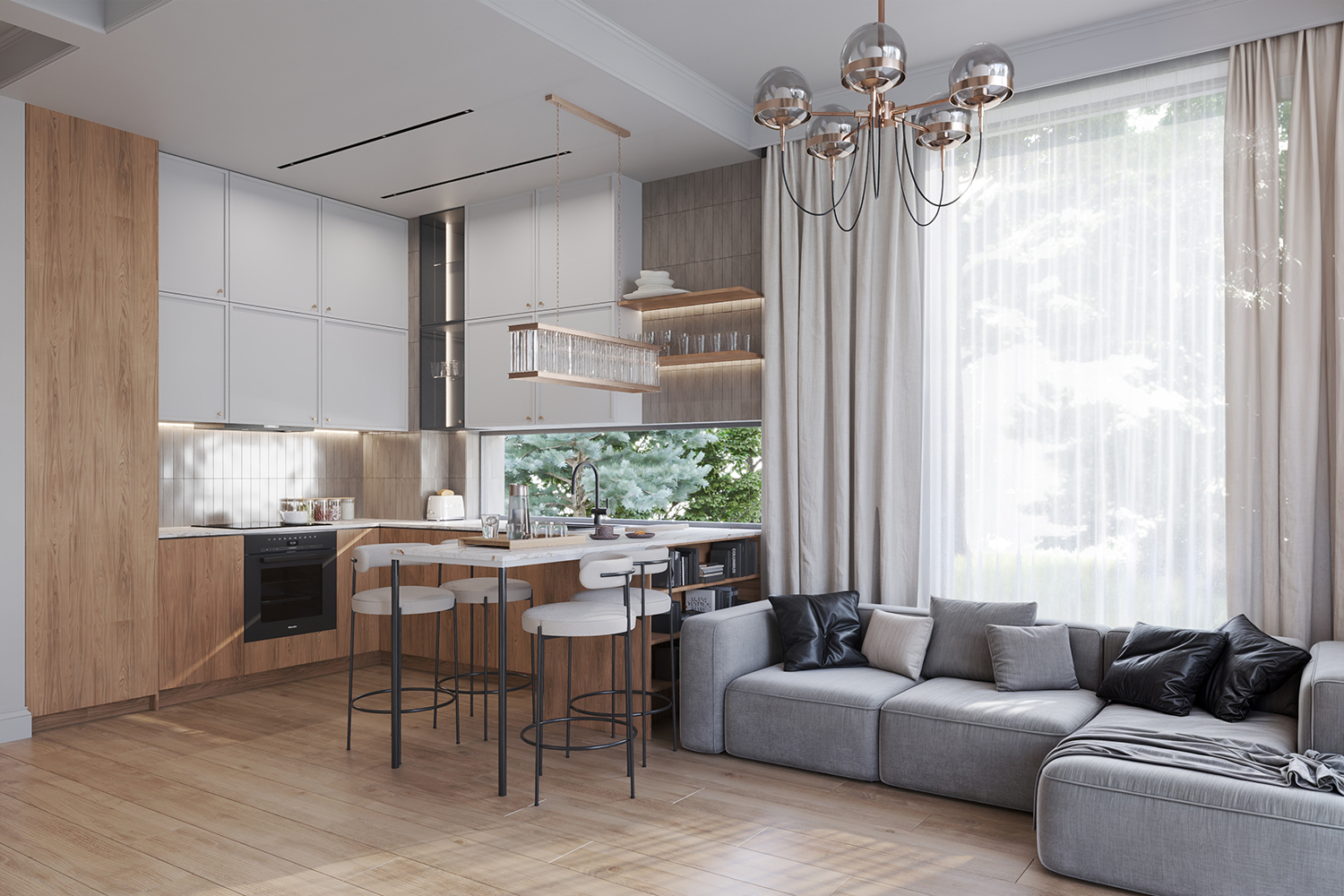

A kitchenette with a living room? How to do it right?
There are three methods for planning a kitchenette with a living room:
- The first method assumes that the kitchenette will be as inconspicuous as possible. Subdued, unobtrusive materials are chosen for its creation.
- The second method allows for the emphasis on both functions of the room through the interplay of materials and colors. This is the most common and widely used solution. If you’ve ever seen kitchen cabinets with a wooden countertop, and then slats on the living room wall in the same wood shade – this is precisely the kind of combination we’re talking about.
- The third method involves completely separating the kitchen and living room using color. A well-chosen material can visually enlarge the room and create a clear division between the kitchen and living room. However, it’s important to remember that ultimately, it’s still the same room, and even different colors should complement each other.
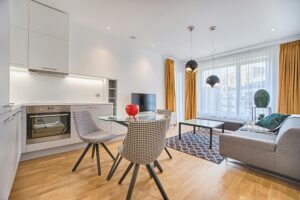
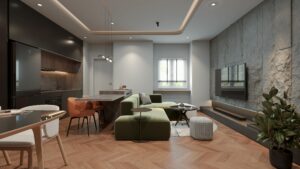
Although a kitchen-living room arrangement is currently the most popular solution among apartments on the developer market, it’s not always the best. In a space like a living room-kitchen arrangement, distances are paramount. These distances are necessary to comfortably use all available space without interfering with each other.
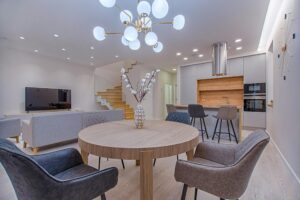
It’s worth remembering that…
- If you’re planning a kitchen island with a sink or hob on it, its dimensions should be no smaller than 90 x 90 cm. Although islands measuring 120 x 90 cm or larger are best
- If the kitchen island has cabinets or drawers that open towards the kitchen cabinets, the distance from the cabinets to the island should be no less than 120 cm. This is the optimal distance to allow two people to pass between the units and to allow for simultaneous opening of cabinets on both sides.
- Include at least 60 cm for walkways. Also, remember that the “path” from the door to the kitchen or from the door to the kitchen sink will be the most frequently used. Therefore, it’s worth ensuring a suitable walkway.
- In the living room, it’s worth planning a single general lighting fixture that provides diffused light throughout the room.
In the kitchen, it is necessary to plan functional lighting that will be stronger and whose color temperature will be around 4000 K (neutral color)
It is also worth remembering about working lighting above the countertop (e.g. in the form of an LED strip) and reading lighting in the living room (a wall lamp above the armchair or a floor lamp will work great)